

Free Italian verb conjugator by Intrepid Italian
Venire Conjugation
Complete conjugation tables for the Italian verb venire (to come)
Free verb conjugator
Conjugate Italian Verbs
Search for any Italian verb to see its complete conjugation
venire
irregularto come
Irregular in: presente, passato remoto, futuro, condizionale, congiuntivo presente, imperativo, participio passato
Compound tenses use essere
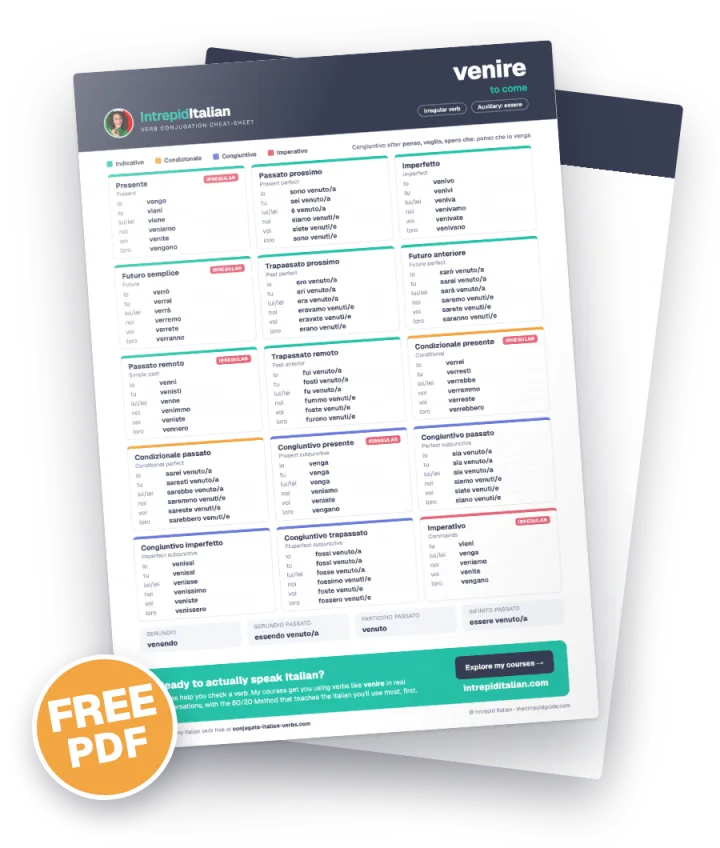
Get your FREE venire cheat-sheet
Every tense of venire (to come) on one printable page.
- ✔ All 14 tenses + the imperative
- ✔ English tense names, irregulars flagged
- ✔ Print it, stick it on the fridge, practise!

How to learn Italian SO FAST it feels like cheating![FREE 30-Page eBook]
Just tell me where to send it!

🇮🇹 What is your Italian level? ✏️ Take the FREE test!
Test your grammar, vocabulary, reading and listening, get your level from A1 to C2, and see the best next step for you.
Take the free test →Examples and common mistakes
How to use venire in Italian
Venire means 'to come'. It is irregular (vengo, vieni, viene, veniamo, venite, vengono; futuro verrò; past participle venuto) and takes essere, so the participle agrees with the subject: è venuto, è venuta.
Venire in example sentences
Presente
Vengo dall'Australia, e tu?
I come from Australia, and you?
Presente
Lei viene alla riunione domani?
Are you coming to the meeting tomorrow? (formal)
Passato prossimo
I miei cugini sono venuti a trovarci a Pasqua.
My cousins came to visit us at Easter.
Imperfetto
Mia nonna veniva sempre a prendermi a scuola.
My grandmother always came to pick me up from school.
Futuro semplice
Verrò a Roma a settembre.
I'll come to Rome in September.
Imperativo
Vieni a cena da noi sabato!
Come to dinner at ours on Saturday!
Common mistakes with venire
Wrong: Anna ha venuto alla festa.
Right: Anna è venuta alla festa.
Venire takes essere, and the participle agrees with the subject, so a woman 'è venuta'.
Wrong: Sono venito in treno.
Right: Sono venuto in treno.
The past participle of venire is irregular: venuto, not venito.
Wrong: Domani venirò con te.
Right: Domani verrò con te.
Venire has a shortened future stem, verr-, so it is verrò, verrai, verrà.