

Free Italian verb conjugator by Intrepid Italian
Stare Conjugation
Complete conjugation tables for the Italian verb stare (to stay, to be)
Free verb conjugator
Conjugate Italian Verbs
Search for any Italian verb to see its complete conjugation
stare
irregularto stay, to be
Irregular in: presente, passato remoto, futuro, condizionale, congiuntivo presente, congiuntivo imperfetto, imperativo
Compound tenses use essere
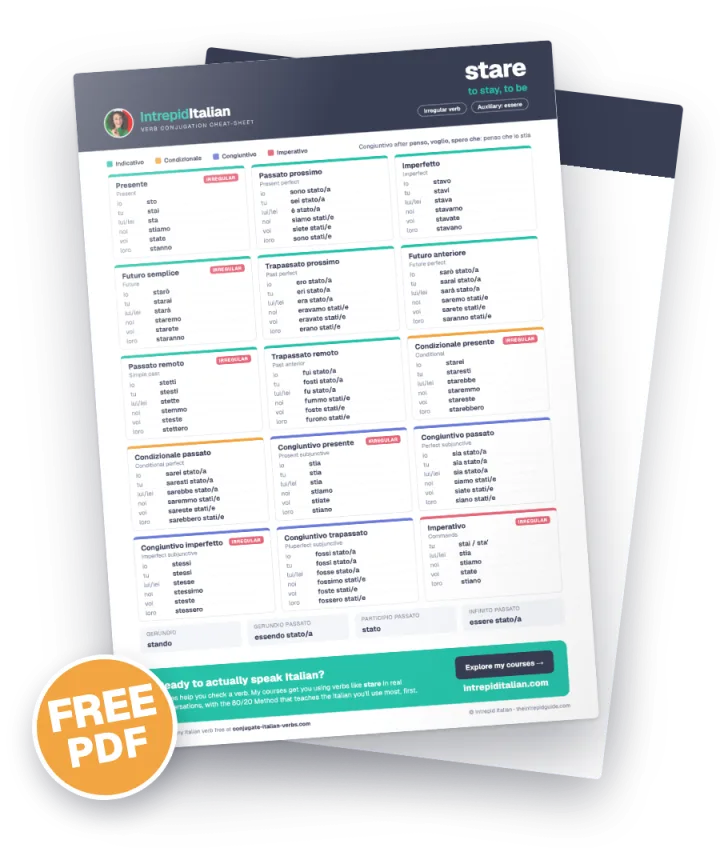
Get your FREE stare cheat-sheet
Every tense of stare (to stay, to be) on one printable page.
- ✔ All 14 tenses + the imperative
- ✔ English tense names, irregulars flagged
- ✔ Print it, stick it on the fridge, practise!
How to learn Italian SO FAST it feels like cheating![FREE 30-Page eBook]
Just tell me where to send it!

🇮🇹 What is your Italian level? ✏️ Take the FREE test!
Test your grammar, vocabulary, reading and listening, get your level from A1 to C2, and see the best next step for you.
Take the free test →Examples and common mistakes
How to use stare in Italian
Stare means 'to stay' or 'to be' when talking about health, location and temporary states (come stai?). It forms the present continuous with the gerund (sto mangiando) and 'to be about to' with stare per, takes essere, and shares its past participle stato with essere.
Stare in example sentences
Presente
Buongiorno, signora, come sta?
Good morning, madam, how are you? (formal)
Presente
Sto cucinando, ti richiamo dopo.
I'm cooking, I'll call you back later.
Passato prossimo
Sabato siamo stati a casa tutto il giorno.
On Saturday we stayed at home all day.
Imperfetto
Stavo per uscire quando ha chiamato Luca.
I was about to go out when Luca called.
Futuro semplice
Starò da mia zia per una settimana.
I'll stay at my aunt's for a week.
Imperativo
State tranquilli, ci penso io!
Don't worry, I'll take care of it! (plural)
Common mistakes with stare
Wrong: Ciao, come sei?
Right: Ciao, come stai?
To ask how someone is, Italians use stare. 'Come sei?' asks what someone is like as a person.
Wrong: Sto mangio adesso.
Right: Sto mangiando adesso.
The present continuous needs stare plus the gerund (-ando or -endo), not the present tense.
Wrong: Ieri ho stato a casa.
Right: Ieri sono stata a casa.
Stare takes essere in the passato prossimo, and stato agrees with the subject, so a woman says 'sono stata'.