

Free Italian verb conjugator by Intrepid Italian
Divertirsi Conjugation
Complete conjugation tables for the Italian verb divertirsi (to have fun)
Free verb conjugator
Conjugate Italian Verbs
Search for any Italian verb to see its complete conjugation
divertirsi
regularreflexiveto have fun
Compound tenses use essere
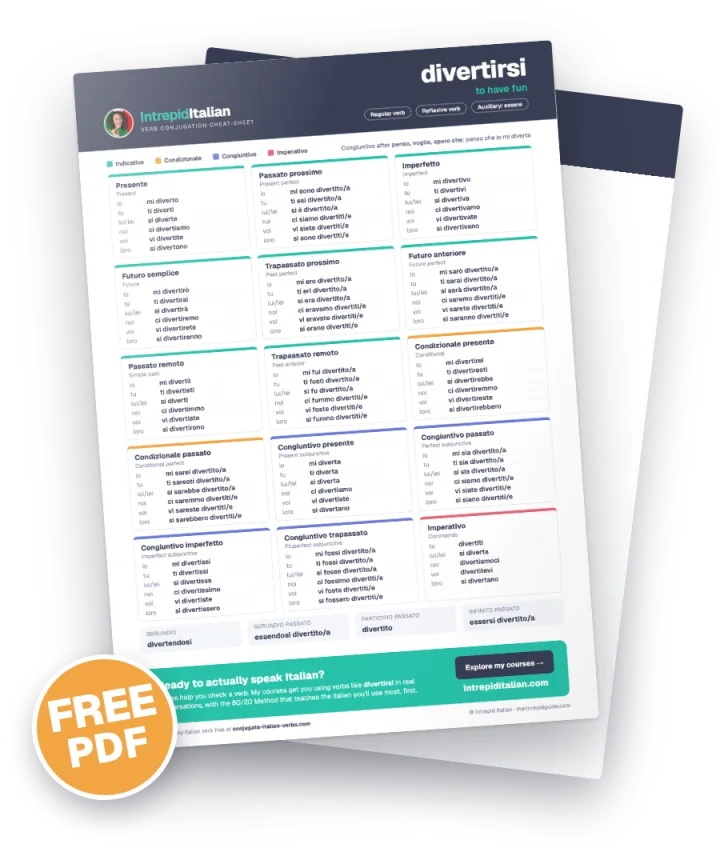
Get your FREE divertirsi cheat-sheet
Every tense of divertirsi (to have fun) on one printable page.
- ✔ All 14 tenses + the imperative
- ✔ English tense names, irregulars flagged
- ✔ Print it, stick it on the fridge, practise!
How to learn Italian SO FAST it feels like cheating![FREE 30-Page eBook]
Just tell me where to send it!

🇮🇹 What is your Italian level? ✏️ Take the FREE test!
Test your grammar, vocabulary, reading and listening, get your level from A1 to C2, and see the best next step for you.
Take the free test →Examples and common mistakes
How to use divertirsi in Italian
Divertirsi means 'to have fun' or 'to enjoy yourself', and Italians use it wherever English says 'have a good time'. It is a reflexive -ire verb, so it takes essere in compound tenses and the participle agrees: ci siamo divertiti, ci siamo divertite.
Divertirsi in example sentences
Presente
Mi diverto sempre con i miei cugini.
I always have fun with my cousins.
Passato prossimo
Ci siamo divertite un sacco alla festa!
We (all female) had a great time at the party!
Imperfetto
Da piccoli ci divertivamo con poco.
As children we had fun with very little.
Futuro semplice
Vedrai che ti divertirai a Venezia!
You'll see, you'll have a great time in Venice!
Imperativo
Buon viaggio e divertitevi!
Have a good trip and have fun! (plural)
Congiuntivo presente
Spero che si diverta, signora.
I hope you enjoy yourself, madam. (formal)
Common mistakes with divertirsi
Wrong: Ieri sera ho divertito molto.
Right: Ieri sera mi sono divertito molto.
Divertirsi is reflexive, so it needs the pronoun and takes essere in the passato prossimo.
Wrong: Abbiamo avuto molto divertimento.
Right: Ci siamo divertiti molto.
Translating 'we had a lot of fun' word for word sounds odd. Italians simply say ci siamo divertiti.
Wrong: Le ragazze si sono divertito.
Right: Le ragazze si sono divertite.
With essere, the participle agrees with the subject: feminine plural takes -e.