

Free Italian verb conjugator by Intrepid Italian
Dire Conjugation
Complete conjugation tables for the Italian verb dire (to say, to tell)
Free verb conjugator
Conjugate Italian Verbs
Search for any Italian verb to see its complete conjugation
dire
irregularto say, to tell
Irregular in: presente, imperfetto, passato remoto, congiuntivo presente, congiuntivo imperfetto, imperativo, participio passato
Compound tenses use avere
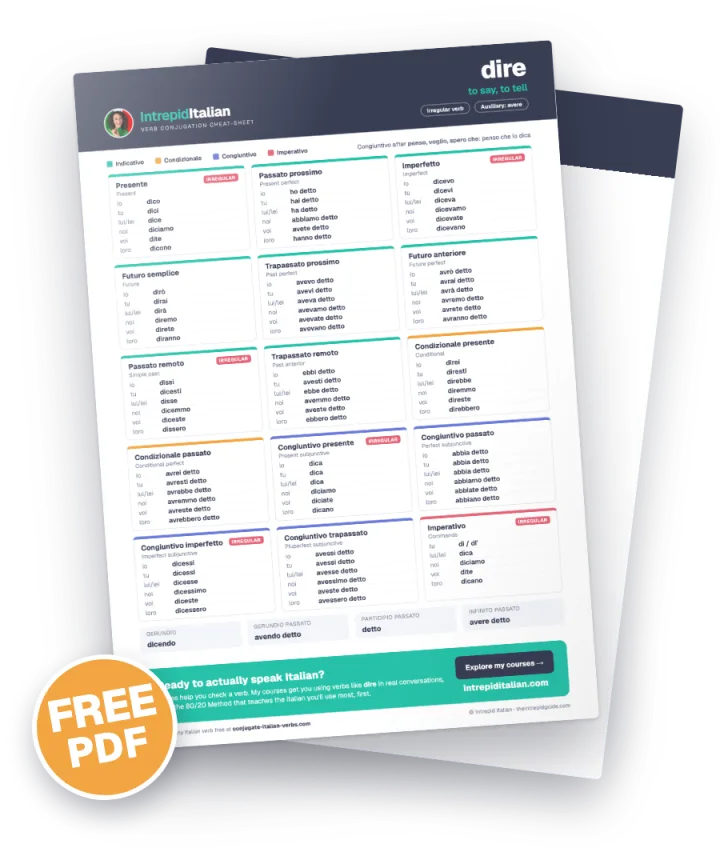
Get your FREE dire cheat-sheet
Every tense of dire (to say, to tell) on one printable page.
- ✔ All 14 tenses + the imperative
- ✔ English tense names, irregulars flagged
- ✔ Print it, stick it on the fridge, practise!
How to learn Italian SO FAST it feels like cheating![FREE 30-Page eBook]
Just tell me where to send it!

🇮🇹 What is your Italian level? ✏️ Take the FREE test!
Test your grammar, vocabulary, reading and listening, get your level from A1 to C2, and see the best next step for you.
Take the free test →Examples and common mistakes
How to use dire in Italian
Dire means 'to say' or 'to tell' and takes avere. It comes from the Latin dicere, so many forms use the stem dic- (dico, dici, dicevo, dicendo), and the past participle is detto.
Dire in example sentences
Presente
Come si dice 'fork' in italiano?
How do you say 'fork' in Italian?
Presente
Scusi, mi dice dov'è la stazione?
Excuse me, can you tell me where the station is? (formal)
Passato prossimo
Marco mi ha detto che arriva alle otto.
Marco told me he's arriving at eight.
Imperfetto
Mia madre mi diceva sempre di mangiare la verdura.
My mother always told me to eat my vegetables.
Futuro semplice
Gli dirò tutto domani.
I'll tell him everything tomorrow.
Imperativo
Dimmi la verità!
Tell me the truth!
Common mistakes with dire
Wrong: Ho dicito di sì.
Right: Ho detto di sì.
The past participle of dire is irregular: detto. It is worth memorising as it comes up constantly.
Wrong: Ho detto lui di venire.
Right: Gli ho detto di venire.
You say something a qualcuno, so 'him' becomes the indirect pronoun gli, placed before the verb.
Wrong: Lui direva sempre così.
Right: Lui diceva sempre così.
The imperfetto is built on the old stem dic-: dicevo, dicevi, diceva.