

Free Italian verb conjugator by Intrepid Italian
Avere Conjugation
Complete conjugation tables for the Italian verb avere (to have)
Free verb conjugator
Conjugate Italian Verbs
Search for any Italian verb to see its complete conjugation
avere
irregularto have
Irregular in: presente, passato remoto, futuro, condizionale, congiuntivo presente, imperativo
Compound tenses use avere
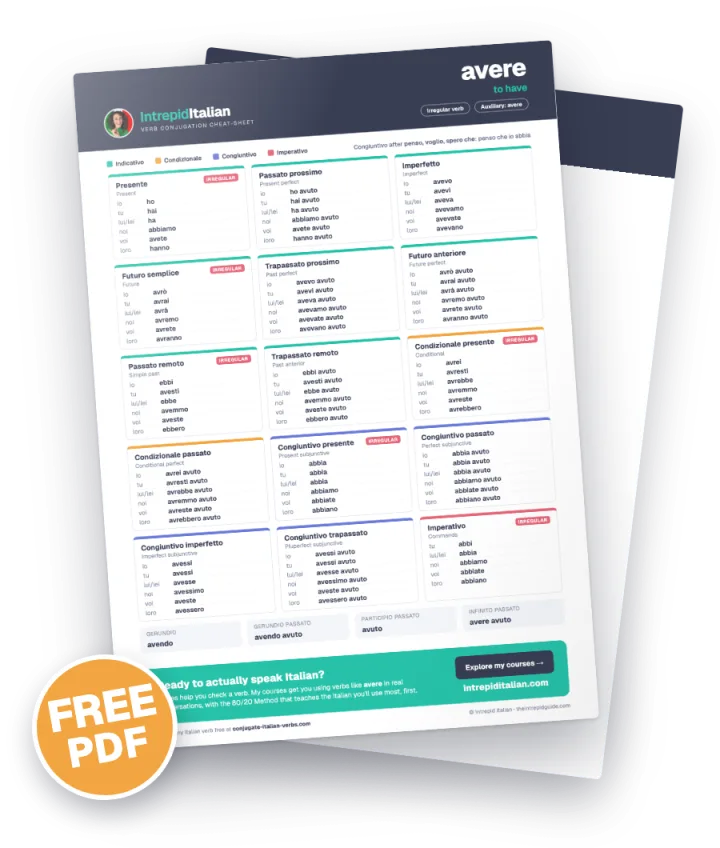
Get your FREE avere cheat-sheet
Every tense of avere (to have) on one printable page.
- ✔ All 14 tenses + the imperative
- ✔ English tense names, irregulars flagged
- ✔ Print it, stick it on the fridge, practise!

How to learn Italian SO FAST it feels like cheating![FREE 30-Page eBook]
Just tell me where to send it!

🇮🇹 What is your Italian level? ✏️ Take the FREE test!
Test your grammar, vocabulary, reading and listening, get your level from A1 to C2, and see the best next step for you.
Take the free test →Examples and common mistakes
How to use avere in Italian
Avere means 'to have' and is also the auxiliary for most verbs in the passato prossimo (ho mangiato, ho visto). Many states that English describes with 'to be' use avere in Italian: avere fame, sete, freddo, caldo, paura, ragione and avere ... anni.
Avere in example sentences
Presente
Ho fame, andiamo a mangiare?
I'm hungry, shall we go and eat?
Presente
Buonasera, ha una camera libera per stasera?
Good evening, do you have a free room for tonight? (formal)
Passato prossimo
Abbiamo avuto un problema con il volo.
We had a problem with the flight.
Imperfetto
Quando avevo vent'anni, vivevo a Milano.
When I was twenty, I lived in Milan.
Futuro semplice
Avrai tempo domani pomeriggio?
Will you have time tomorrow afternoon?
Imperativo
Non abbiate paura di sbagliare!
Don't be afraid of making mistakes! (plural)
Common mistakes with avere
Wrong: Sono fame.
Right: Ho fame.
Hunger, thirst, fear and feeling hot or cold are things you 'have' in Italian, so they take avere.
Wrong: Lui a due figli.
Right: Lui ha due figli.
The h is silent but essential: ha is the verb, while a is the preposition 'to' or 'at'.
Wrong: Ho bisogno un taxi.
Right: Ho bisogno di un taxi.
Avere bisogno always needs di before what you need, just like 'in need of' in English.